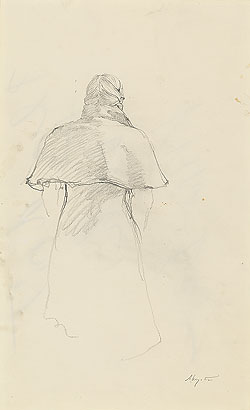
Ben Shahn Allegory (American 1948)
Over the weekend, in a crowded theater in the Pittsburgh Filmmakers' Melwood Screening Room, I saw the premiere of Carl Cimini's documentary, Dancing in Amdo. I had certain expectations, primarily because, apart from a warm acquaintance with Carl, one of my closest friends, Todd, joined the filmmaking journey to India to record the audio tracks. I have been relayed enough anecdotes and unfilmable moments from the voyage that the movie itself had come to feel like a mere index, something useful in cementing the free-floating pieces of a journey into a conventional narrative form, but in and of itself secondary.
The look and sound were very much what I'd hoped for, which is to say gritty, and not so different from the way we remember travel: arrested pictures of a moving world, and then rambling attempts to catch hold of it again. It is something I grew to love in Harmony Korine's movies--maybe the best of this generation.
My big question at the premier, which went unasked, though not unanswered exactly, was how this was supposed to appeal as a work of art? Was he happy with the pictures and sounds they collected? Is the skin of political and religious purposes a red herring? Now, in my defense I don't go around asking "is it art?" every time I'm forced to wear a button-down Oxford outside the office, but personal relationships being what they are I couldn't help it. I wanted to connect the dots between the movie and the aspirations.
It's not that I was scared to ask the "art" question--though phrasing it tactfully is seldom easy. As time went on, both in viewing, and in the ensuing q&a, the consensus was that artistic merits had limited space in the discussion--though in plugging another movie culled from the same voyage, Carl distinctly tipped his hat. The audience had political questions, religious questions. Fine, fine.
Carl opened the night by congratulating the audience for being among the enlightened one percentile of moviegoers willing to see either a documentary or a subtitled movie, noting with wry pride that Dancing was both. I imagine most of the folks in attendance would've contended that the lively discussion that followed testified to the success of the film-as-art--though as much of that discussion emanated from globetrotting bloviators and trust fund bleeding hearts. The lot of them reminded me of one of my first masters lit classroom discussions. The short story was Andre Dubus' "The Fat Girl". It was about a fat girl, and all anyone could say was gee, fat girls have it rough. And God, people can be so cruel.
The reason this question of art ran so contrary to the heart of the audience's discussion is that, contrary to surface appearances, Dancing in Amdo is not a political movie. Nor is it a religious movie. It is, quite purely, a document of curiosity. A manifestation of action and time spent. Anything beyond that obscures the very real and rewarding story, a story that, I might add, is not the Dalai Lama's, nor the monks' in whose company he practices, nor the peoples' of India, nor the peoples' of Tibet.
Perhaps it was the absence of a first person narration--the "traveler's voice". Certainly it owed something to the distractingly large subject being sought: call that the Dalai Lama, the essence of Tibetan Buddhism, or whatever you like.
Still, I found the most magnetic--the most instantly magnetic, quality of the film to be that engine of curiosity. The movie is filled with new things. Most of us had never seen the rituals, the art (how very much like western Modernism those young Tibetan paintings are) and walking-around lives of these places before. It was a kind of coming alive.
I read something the late American artist, Ben Shahn, wrote in his essay, "The Biography of a Painting", which I thought lent itself nicely to the issues I faced in seeing this movie. In it he described his reaction to a negative criticism he received for one of his paintings, at the hands of a close friend and critic, Henry McBride. The story goes that after a long, almost predictably favorable, critical relationship with Shahn, McBride saw in 1948's Allegory, violent, politically charged elements which, he felt, disagreed with the temperament of the artist. Shahn pored over the DNA of his work, examining it for any correlation to the points his friend made against it. He found none.
Instead the artist steeled himself with the words of another critic, Clive Bell:
The representative element in a work of art may or may not be harmful, but it is always irrelevant. For to appreciate a work of art, we must bring with us nothing from life, no knowledge of its affairs and ideas, no familiarity with its emotions.
Wasn't this what I'd just been thinking? What Shahn then added, however, was that personal artistic confession. Yes the external world is irrelevant to art, but no it cannot be excluded. Shahn, rather than accepting this tenet quietly, named the historical, then autobiographical, and finally mythological symbolisms which might have informed Allegory. He knew the irrelevance about which Bell spoke, but could find no comfort in it. Nor could he resist succumbing to it.
***
The life of a movie is strange. I remember a picture from one of Bob Dylan's Hollywood scrapbooks, it depicted a stirring crowd at the center of which was an aged Marlene Dietrich looking sad and confused. The occasion was Gary Cooper's funeral. What struck me about it was how Dietrich's iconographic aura broke down for me in that instant. As if seeing her made her the human being I never knew in her movies. Perhaps Dancing in Amdo worked on such a profound level for me for the exact opposite reason: with the transgression of dragging the external world into art, I saw people I knew, or at least the traces of their story, as something devastatingly outside my world.
UPDATE: This is sorta sidetracking, but the fantastic Artblog by Bob has recently, coincidentally, chimed in on Ben Shahn. As ever his clarity and incisiveness inspire me with due love (and envy). What do they put in that Philadelphia water!?