Showing posts with label Philadelphia. Show all posts

Saturday, September 13, 2008

I like to pretend you're the other.


Two records continue to blissfully haunt me from Philadelphia, each with the magnitude and erotic charge of Deborah Kerr in a nun's habit.  The first is--I suppose this one is kinda obvious, Billy Paul's  360 Degrees of Billy Paul.  It did indeed yield one of the great Philly soul hits, "Me & Mrs. Jones", which I continue to love--though for my money, Candi Staton's "Mr. & Mrs. Untrue" can't be beat.  Paul's throaty, scatting delivery peaks on Carole King's "It's Too Late".  Fucking sincere and awesome!

The other is one folks who know me well have probably grown a little tired of my touting so persistently.  I can't help it: Van Morrison's Veedon Fleece is astonishing stuff.  I'm all hung up on the arrested development on the opener, "Fair Play".  Morrison's signature stream-of-consciousness lyrics were dead by 1974, when this homecoming lament was recorded, if critics are to be believed.  Though as I'm increasingly inclined to say, "to hell with the traditional media".  Old Ivan turns the shipwreck of marriage and America into a stirring celtic woundsalve.  "Fair Play" is like Coleridge's "This Lime Tree Bower", so rife with natural endorsements, and emotional frailty.  So much spiritual violence warming around a juvenile human center; Van sounds angelic.  There's William Blake, Geronimo, a laudable Levon Helm impersonation, and a soulful falsetto so broad and deeply penetrating that everyone from Sinead O'Connor, to Prince, to name-your-blue-eyed-soul hot thing, owes it a long genuflection.   
I'm still learning the mp3 link thing for the Mac, so, alas, no free downloads right now.  But maybe if lightning strikes my kite tonight I'll have something up by morning.  Short of the that, and regardless of that, go out and buy em.  The world is so full.  

Wednesday, August 20, 2008

The Restlessness That's In Me


Later than I would have liked I realized there was no chicken.

There's always gotta be chicken in the refrigerator because the dog has special dietary needs, and chicken's one of them. It's too much of a nuisance to wake up in the morning, walk her, and still find time to get ready for work, to cook and separate chicken. I can't do it. So last night, later than I would have liked, I got dressed and went out to buy the dog's chicken.

I recently added Richard Hawley's Coles Corner to my iPod. The air was cooling to that perfct pitch. It's a terrific record anytime, but played in those pivotal hours between seasons it becomes Mahlerian--an auburn punctuation jutting out over nature like a diving board or the chrome fenders of the 1950's .

Also, it's true, and perhaps universal, if subtle enough to have gone largely undetected over the ages, that cities and ex-girlfriends are at their most beautiful the last time you see them.
It's as though you're all of a sudden up and aware of things.

As for this city, a storm might have erupted last night, but it didn't. For a while the winds ran, and the lowest places in the sky, right where they met the trees and rooflines, were full of defining color (Wassily Kandinsky called blue "the religious color"). Best of all was how uncannily empty the streets were, not just of people but of all sound. A cryptic young man at a bus stop solicited me for either drugs or sex--not totally sure which. He seemed nice enough, so I just told him I wasn't into it and left him there. Not another human soul for the rest of the evening.

Coles Corner was written about a place in Hawley's Sheffield, where everybody met, and where everybody's parents met, and their parents, and their parents. He seems to be always merging the soil and loveliness of the city with the descending love that keeps happening there. Many of his songs have the depth of the Romantic poets, whose works must have cued him and fostered that eternal quality.

In listening I was reminded of things I hadn't thought of in twenty years; I could feel my pores opening up. I thought about my cousin, Tammy, showing us the man with an erection hidden in the camel on a pack of cigarettes. The marred toy figure head that always lead me to momentary plots to switch it out with another boy's. I resisted, but carried the compulsion for what then seemed like ages. And so on.

This isn't exactly a record review--one, because of the age of Coles Corner, and two, the obvious fact that I'm distracted, I'll leave it there. Perhaps it's best to add that there's a ton of great Ricky Nelson, Dean Martin and Roy Orbison manly lonesomeness. Oh and a towering symphonic presence. Maybe a little self-pitying Sinatra too, which is nice. What I meant to talk about was the night, which, forgive me for misleading you up til now, seems out of my reach just now.

Sunday, August 10, 2008

I could press my hand on the door where you both were.


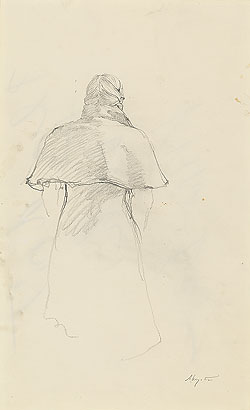
Andrew Wyeth Helga (American 1970?)

You'll have to pardon me. It's another Sunday morning, and I'm in the mood of solipsism and romance.

Andrew Wyeth, I learned yesterday, is a mild expletive in these parts, begrudged for the incident of his celebrity, and nipicked for his style and technique. At least among the circles I travel.

He provoked the Main Line Chernobyl incident of 1986. And by incident I mean: wild love; and by Main Line I mean:

I could press my hand on the door where you both were.

While pecking out the Jonathan Richman review I tried to think of an image that evoked the album title, Because Her Beauty is Raw and Wild. My first flash thought was of Helga Testorf and Andrew Wyeth. Recently, my parents came to town to see a show, and I was beached for ideas on how to keep them entertained. I told my dad that the Society Hill towers were designed by I. M Pei, and that about five blocks from them was, in the lobby of an old office building, a sprawling mural by the Philadelphia-born artist, Maxfield Parrish, how it's like a great scare in a horror movie. No matter how many times you see it, and train your imagination to know its there, you simply cannot prevent the surprise. Since we didn't actually go see to see it, I'm sure the effect remains sadly unaccomplished in them both.

You can't get them to go goddamn anywhere.

I handed my mom a book of the Helga pictures. Her first response was that these people, the artist and model, were unmistakably in a kind of unhidden love. I didn't know the story. Yeah, probably.

Then this Raw and Wild thing happened, and I came across Bob's site, which is terrific. Great insights and choices. You can read his account there (just click on the name of the blog in he linked entry above to be redirected to his most recent post, which I also highly recommend), of the secret creative relationship carried on between Wyeth and Helga, whom he contracted as his nurse in 1971, and with whom he continued well into the 1980's. What struck me about the story itself, and by Bob's recapitulation was the--I think--noble desire to find shock in the human routine. And especially in creative affairs. Perhaps it is that moviemaking as an artform is graying, or that tabloids curdle our taste for banal sensations. We feel guilty, or somehow above this kind of investigation. But we ought not. This is, as Bob duly comments, a remarkable story.

I suppose it is also sort of timely just now, given the breaking news of John Edwards' affair with Rieile Hunter, a videographer he met while campaigning several years back. I've read the outrage of bloggers and in comments columns to the news stories. The reactions have been varied, and most often concern what this guy did to the Democratic Party and to his cancer-stricken wife. Not knowing those involved personally I can only say the truth of both impacts might be greater than I could imagine. Though I suspect it is far smaller. Or more accurately, greater only in the external soul that keeps it alive because there is a need for the warmth of our own mistakes, and when it is too awful or inconvenient to consider we look outside. I do genuinly hope, against the grain of our shared politics and all the good she's done, that when Arianna Huffington's own misdeeds come to light, there might be a force as meddlesome and petty as hers to burn a cross-shaped souvenir into her forehead. But I digress.

You see the idea is fascination, not purposeless snooping. Not sportsman's cruelty. Again, I digress.

Of course there is a fundamental difference between the two affairs, that being the progeny. For the Edwardses it must be a rancid comeuppance: all humiliation, pity, and scorn. The commentors and bloggers want to know how these enomous errors could have happened. Poor politicians, poor suicide monkeys.

With the Helga situation that question doesn't apply. There is an articulate. and moreover purposeful, asking at work in the paintings--over 200 of them in total. It is not to say an enormous error wasn't made, only that something full of living light and brown earthliness overgrew it.

Sunday, July 27, 2008

On Updike, Joe Boruchow, and the unnavigatable light


Joe Boruchow-poster (2008 S. Phila.)

Special thanks to my good friend, and the estimable artist, Joe Boruchow. He rather intuitively, and quite graciously, linked me to a handful of New York Review of Books essays in an attempt to legitimize John Updike out of my ignorance and resistance. Quick work was made.

Joe and I had been discussing American artists as I was newly aware of Alsatian-American illustrator/artist, Tomi Ungerer. (I urge you to check the link, especially you graphic-period Warhol enthusiasts.) As is so often the case Joe steered us into the earnestness (or at least matte silverness) of America, tapping into, and sharing, my love of Ben Shahn, Max Fleischer, and George Herrimann. Eventually he alit on Updike, whom as I explained a moment ago, had never worked high in my regards. What he (Joe) really loved were these essays Updike wrote as art critic for The NYRoB. So he sent me a few. I had been drastic in my opinion of John Updike. He's always been too much of a golden calf to really enjoy, too expectedly loved; somewhere there's a back issue of Informed Audience Member Quarterly with him on the cover standing between Joni Mitchell and David Hockney smoking a Churchill. On the wall above the fireplace: Raphael.

The essay, which is sturdy as an Amish nightstand, is called "The Clarity of Things", and it concerns the definition of American Art: For such a presumptuous topic I totally enjoyed it.

I mentioned to Joe that I was moving back to Pittsburgh for a while. In his wrathful halcyon Andrew Carnegie had acquired himself a lion's share of the great American paintings of the 19th century. Certainly I gushed over John Singer Sargent's epiphanous Venetian Interior 1882, and how one of the maids depicted, in her diagonal journey across the canvas, meets with only the tip of her toe a cross-current of sunlight. And how the meeting is no less flagrant and stimulating than when Eve met the Snake. Hearts destroyed, boners attained, privileges lost, etc., etc.

And there were the neo-Classicals--categorical or by warp of history, like Ingres, Courbet, and David who practically fathered the American style (add Walt Whitman and a bay leaf and you're there). In their times they were inflammatory, and at least in Courbet's case, considered somewhat garish for his stylistic determination. I remembered hearing Elizabeth Schumann's sillysad Lieder when I discovered a book of David in a thrift shop years ago. My initial reaction, doubtless emphasized by the metered loveliness of the song--which is why I mention it, was how stealthily David had been an influence on Edward Hopper. The signs are not instantly met. But look in each, and you can find the shared light of abandonment on the figures. It is as if David had taught the American pastoralist a kind of vocational cruelty: you drive them out to the middle of nowhere, in your case Maine, and you leave them there to navigate the light. The results were ecstatic.

So I've made my peace with John Updike, occupation: essayist. My ambivalence for the novelist endures. But then, I don't seem to care for any novelists. Their demands go unrewarded; which of them knows how to finish something he started?! Not so many. Not even the greats. Joe has been reading Willa Cather, and I still tote around Speak, Memory returning to it like a grocery list: I don't want to be surprised, I'm practically 33. How do I feed myself? You'd be surprised how rapid and reliable an answer I get. Perhaps it's not a novel, though it satisfies the demands of one with out griping.

Maybe all style is griping; I still haven't settled on a way to write this thing in a way that satisfies me. A friend, and writer, whose work I respect very much recently said to me, "I enjoy your blog, though I'm not sure I always "get it"". You know, that film is on the insides of these windows too. You scrawl not because it makes sense, but because with your fingers you've, sloppily and with the last mechanical vestiges of being a child, found a way to invite a thing in.