Sunday, August 31, 2008

Purple Stuff


Some great S. Philly pics, taken over the past few weeks with the phone camera--a much-needed recess from that purple high school stuff I'd been writing. Sometimes I do have trouble helping myself. Anyhow, I picked up a few rolls of film for the Holga, and will be putting up the pics I take as they're developed. The writing will go back to beige, I'll spin some Corelli with commentary, doubtless one of those rich Borodin concertos that conjure visions of dried blood on Italian marble stairs, and all things evoking the pristine and sublime. Hope all is well in Philadelphia, all is well in Pittsburgh!

Speaking of which, you'll see, newly restored to my blogroll, is the left-for-dead Pittsburgh fave, 7 Inch Slam. I have my vigilant pal Max Milgram of the recently debuted Watery Love to thank for keeping an eye out; I was sure 7 was done for good. He doesn't write as often as he once did, though he's always a terrific read. I plan to meet him at high noon in a show down of gustatory and auditory paraphernelia. His fried chicken and punk rock 7's vs my bucatini nicoise and doo wop. Smart money's on him.

Sunday, August 24, 2008

fasolakia


No energy. Must continue to pack. Moving.

In the meantime sorry for slacking off. I'll get back on the horse just as soon as I'm situated. Here's a gander at what was likely the last real meal I will have made in Philadelphia; for those of you who got some, I hoped you liked it. For those who didn't, I was pretty bent up when I ladled it out. Oh, and I added oil-cured olives which, though absent from any recipe I've ever worked from, gave it that Hamburger Helper gestalt I'm always looking for.

Wednesday, August 20, 2008

The Restlessness That's In Me


Later than I would have liked I realized there was no chicken.

There's always gotta be chicken in the refrigerator because the dog has special dietary needs, and chicken's one of them. It's too much of a nuisance to wake up in the morning, walk her, and still find time to get ready for work, to cook and separate chicken. I can't do it. So last night, later than I would have liked, I got dressed and went out to buy the dog's chicken.

I recently added Richard Hawley's Coles Corner to my iPod. The air was cooling to that perfct pitch. It's a terrific record anytime, but played in those pivotal hours between seasons it becomes Mahlerian--an auburn punctuation jutting out over nature like a diving board or the chrome fenders of the 1950's .

Also, it's true, and perhaps universal, if subtle enough to have gone largely undetected over the ages, that cities and ex-girlfriends are at their most beautiful the last time you see them.
It's as though you're all of a sudden up and aware of things.

As for this city, a storm might have erupted last night, but it didn't. For a while the winds ran, and the lowest places in the sky, right where they met the trees and rooflines, were full of defining color (Wassily Kandinsky called blue "the religious color"). Best of all was how uncannily empty the streets were, not just of people but of all sound. A cryptic young man at a bus stop solicited me for either drugs or sex--not totally sure which. He seemed nice enough, so I just told him I wasn't into it and left him there. Not another human soul for the rest of the evening.

Coles Corner was written about a place in Hawley's Sheffield, where everybody met, and where everybody's parents met, and their parents, and their parents. He seems to be always merging the soil and loveliness of the city with the descending love that keeps happening there. Many of his songs have the depth of the Romantic poets, whose works must have cued him and fostered that eternal quality.

In listening I was reminded of things I hadn't thought of in twenty years; I could feel my pores opening up. I thought about my cousin, Tammy, showing us the man with an erection hidden in the camel on a pack of cigarettes. The marred toy figure head that always lead me to momentary plots to switch it out with another boy's. I resisted, but carried the compulsion for what then seemed like ages. And so on.

This isn't exactly a record review--one, because of the age of Coles Corner, and two, the obvious fact that I'm distracted, I'll leave it there. Perhaps it's best to add that there's a ton of great Ricky Nelson, Dean Martin and Roy Orbison manly lonesomeness. Oh and a towering symphonic presence. Maybe a little self-pitying Sinatra too, which is nice. What I meant to talk about was the night, which, forgive me for misleading you up til now, seems out of my reach just now.

Sunday, August 17, 2008

New Life


Another Sunday is upon us, and I enter the two-week period of my departure to Pittsburgh.

Today might have passed without a word, were it not for the one thing in this world I love to kick more than myself: the stereo.

Last night I disinterred William Steinberg and the Pittsburgh Symphony Orchestra's 1962 recording of Brahms' 3rd Symphony in F, and the Tragic Overture. This record had been among the karma-fattening load I donated to A.K.A. in an attempt to thin my holdings. I must have been a little loosey-goosey when I put in on the pile.

Nevertheless, there it was, back on the rack, marked $.99 in that scant classical vinyl bin in the rear of the store. It was like looking at a malnourished racehorse, the musky stable water reflecting poisonous in his eyes. The misspent nobility, and the enduring light. I reclaimed him, rode him home. We had a party.

It was the last record I would ever hear through the Technics SX-303R stereo receiver my folks bought me back in the mid-90's. In the night it finally gave out, kaput, still so warm with the sound that this morning, with coffee in one hand, I pressed the other on the top grill and found a resonant D sustaining. So long.

My pals, Brian and Cher, had mentioned months ago that they had a receiver to spare, and that if I didn't mind lugging it home it was mine.

The Technics SU-8080 might better have come fitted with white-walled tires and leather seats. Add a steering wheel and some plush dice and you have what in 1966 was called with no small amount of awe and national pride, the Lincoln Continental. Heavy. All knobs and switches. No effeminate lights, no LCD displays. Plug it in and it disturbs the peace, begins to steal the oxygen from the room. I'm not by nature a fetishist, and I'm certainly no gear-head, but this device is something else.

I took a shower, Windex'd the picture of my folks, put on a white shirt and my suit, re-read E.B. White's obituary (it's a kind of fit-all ceremonial text in my life), and sat in a businessperson's erect position with my writing hand folded below my chin (oh yeah, I shaved) and weighed the appropriate record with which I might inaugurate this symphonic box of warfare.

Nina Simone's recording debut, Jazz as Played in an Exclusive Side Street Club, was made in 1958, when she was 25 years old. It has remained one of the finest composites of a jazz and folk style with a classical technique. To say it's good, great, or even a classic is selling short how tremendous its presence is, and how enduring is the sound it makes. Perhaps David Berman said it best in a poem about being young and high, in which a prize girl exclaims, "all water is classic water".

Jazz as Played... is so fundamentally and inherently correct and fine that it is redundant to say something nice about it--this too. It blemishes it to say it is perfect, as if saying so introduces the possibility that it may not be so.

This too.

I figured it would suffice, and started with side two. "Good Bait" played, producing a dignified sound. But it was "Plain Gold Ring" moments later that fused the record to the turntable in a kind of self-curating wisdom and marriage. I laid down by a half-drunk glass of water and lemon, and a saucer covered with olive pits and an orange segment, the dog was sleeping on the futon by the record sleeve. The whole scene was reminiscent of the advice you would've gotten from the first few issues of Playboy--provided the scope of the advice did not include yours truly as an example. I'm a mess, but I leave amazing trash.

I refuse to pass out Sunday apologies (you can get those wafers elsewhere), so I'll simply reiterate that there is a round romance laboring through the day, needing from us our gentleness of spirit, our laziness. One might wear gloves and goggles, but miss the reward for the precaution.

I'm telling you, you need a wheelbarrow to carry this thing around.

Wednesday, August 13, 2008

Yes, but it's not this year's shiver...


Gerhard Richter Confrontation 1 (German 1988)

I was pleased to see the lion, Edward Elgar, made news this morning. Amid a controversy no less. To me the late British composer has always been unjustly pinned under the mantle of his own most famous work, the ubiquitous graduation march, "Pomp and Circumstance". There's much to love in his work, and his patently British air. In a recent listen to his Cello Concerto I found myself thinking silver thoughts of thoughtful, recessively romantic actor, Trevor Howard in David Lean's 1945 masterpiece, Brief Encounter. That air seems to know neither sweat nor panic. Celia Johnson runs for the stairs, there's no shortness of breath, no hysterics. Only Rachmaninov.

The flap, since I brought it up, concerns vibrato, a resonant effect prized in today's performances--and, because of spatial and technological conditions of times past, a recent improvement to the presentation of musical performance. As it happened, a conductor named Roger Norrington, a self-appointed restorationist, decided for an upcoming performance of "Pomp and Circumstance" to (maybe!!!!) go back to the old non-vibrato sound that would've been of the element in Elgar's time. The idea was to hear the music as it originally sounded.

To be honest I didn't really have much of a strong opinion on the subject at first, though the argument itself fascinated me instantly. One commentor on The New York Times website decried Norrington's decision as "Taliban-like", while another exclaimed "YUCK" at the very thought of a cello subjected to such vulgar and antiquated treatment. I'm from the School of Put the Mono Version on Disc 1 and the Stereo Version on Disc 2 and You Decide. It's a rock music sensibility, and I have to say, it fosters a less combative discussion.

Or are classical music people always storming around just looking for a fight?

Many of the folks whose responses I read this afternoon came across as musicians themselves. That may be the problem right there; I absolutely never cared what they thought. For one thing the body resonance with their instruments grants them altogether different listening experiences. Not to say they don't own home stereos, or go out to the symphonies on their days off. But as lay people, we the listening set thrive on this kind of contrastive formulation. It is precisely how we come to understand a work of art. What's more it's common for a first impression to be a negative one, and still produce with further, varied exposures, a warm composite concept of the work. Hear the uneasy peace in Leonard Bernstein's introduction to his collaborative performance of Brahms' D Minor Concerto, with pianist, Glenn Gould. That he felt compelled to give prefatory notes at all revealed Bernstein's misgivings. However his subsequent performance fell in with Gould's concept of the Concerto; he bitched a little, then rolled up his sleeves and did his job.

The idea of ridiculing, or worse still occluding, a point of artistic juxtaposition (or at least any one not causing bodily harm or emotional trauma) sounds both foolishly short-sighted and even a little elitist. Added to which there is a pettiness in expecting the comfort of a fulfilled expectation from a musical experience. Many people who responded did so as though the fire of good sense itself had been snuffed out on Elgar's annual vintage.

What fails to resonate in Norrington's chilly Elgar--should he go that route, might yet be made up in performances of years to come, or in the warmth of an unexpected controversy, which requires we wait no longer.

Slurpy-slurpy


Heasly Falstaph-Forty/Forty-Three (American recent)

More Clinton-era reminiscence at Magicistragic...This time it is one Bang!, by the esteemed World Party, from--as Jens Lekman duly calls it, the sweet summer of 1993. Do enjoy.

In the meantime it's bedtime for Bonzo...

Sunday, August 10, 2008

I could press my hand on the door where you both were.


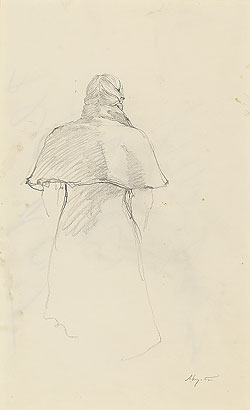
Andrew Wyeth Helga (American 1970?)

You'll have to pardon me. It's another Sunday morning, and I'm in the mood of solipsism and romance.

Andrew Wyeth, I learned yesterday, is a mild expletive in these parts, begrudged for the incident of his celebrity, and nipicked for his style and technique. At least among the circles I travel.

He provoked the Main Line Chernobyl incident of 1986. And by incident I mean: wild love; and by Main Line I mean:

I could press my hand on the door where you both were.

While pecking out the Jonathan Richman review I tried to think of an image that evoked the album title, Because Her Beauty is Raw and Wild. My first flash thought was of Helga Testorf and Andrew Wyeth. Recently, my parents came to town to see a show, and I was beached for ideas on how to keep them entertained. I told my dad that the Society Hill towers were designed by I. M Pei, and that about five blocks from them was, in the lobby of an old office building, a sprawling mural by the Philadelphia-born artist, Maxfield Parrish, how it's like a great scare in a horror movie. No matter how many times you see it, and train your imagination to know its there, you simply cannot prevent the surprise. Since we didn't actually go see to see it, I'm sure the effect remains sadly unaccomplished in them both.

You can't get them to go goddamn anywhere.

I handed my mom a book of the Helga pictures. Her first response was that these people, the artist and model, were unmistakably in a kind of unhidden love. I didn't know the story. Yeah, probably.

Then this Raw and Wild thing happened, and I came across Bob's site, which is terrific. Great insights and choices. You can read his account there (just click on the name of the blog in he linked entry above to be redirected to his most recent post, which I also highly recommend), of the secret creative relationship carried on between Wyeth and Helga, whom he contracted as his nurse in 1971, and with whom he continued well into the 1980's. What struck me about the story itself, and by Bob's recapitulation was the--I think--noble desire to find shock in the human routine. And especially in creative affairs. Perhaps it is that moviemaking as an artform is graying, or that tabloids curdle our taste for banal sensations. We feel guilty, or somehow above this kind of investigation. But we ought not. This is, as Bob duly comments, a remarkable story.

I suppose it is also sort of timely just now, given the breaking news of John Edwards' affair with Rieile Hunter, a videographer he met while campaigning several years back. I've read the outrage of bloggers and in comments columns to the news stories. The reactions have been varied, and most often concern what this guy did to the Democratic Party and to his cancer-stricken wife. Not knowing those involved personally I can only say the truth of both impacts might be greater than I could imagine. Though I suspect it is far smaller. Or more accurately, greater only in the external soul that keeps it alive because there is a need for the warmth of our own mistakes, and when it is too awful or inconvenient to consider we look outside. I do genuinly hope, against the grain of our shared politics and all the good she's done, that when Arianna Huffington's own misdeeds come to light, there might be a force as meddlesome and petty as hers to burn a cross-shaped souvenir into her forehead. But I digress.

You see the idea is fascination, not purposeless snooping. Not sportsman's cruelty. Again, I digress.

Of course there is a fundamental difference between the two affairs, that being the progeny. For the Edwardses it must be a rancid comeuppance: all humiliation, pity, and scorn. The commentors and bloggers want to know how these enomous errors could have happened. Poor politicians, poor suicide monkeys.

With the Helga situation that question doesn't apply. There is an articulate. and moreover purposeful, asking at work in the paintings--over 200 of them in total. It is not to say an enormous error wasn't made, only that something full of living light and brown earthliness overgrew it.

Thursday, August 7, 2008

The Core of the Stars We See


Andrew Wyeth-Helga (American-1970 or after)


Jonathan Richman-Because Her Beauty is Raw and Wild (Vapor 2008)

It's always been my assumption, respectfully, that Jonathan Richman was as true a version of himself as he could communicate, in a specifically cartoonish singer style; he is a pedantic, childlike, anachronistic, eccentric, morose and most of all, silly singer, and I'm guessing he's that kind of guy too. There is such idiotic sophistication in his views of everything from roller-coasters to painkillers that one has to wonder if that bristly vignette about Pablo Picasso from his Modern Lovers days wasn't a sub-conscious look at his own inner pixie dust.

So in his fourth decade of consummating a public image, Richman seems to have eased into a working trance not uncommon to enduring artists: he makes music "for himself". His solo records since the demise of the Modern Lovers have often puzzled, and chafed at, his fan base. Because Her Beauty is Raw and Wild appears to have broken from that myopia, explicitly upon the prolonged illness and death of his mother.

Richman is still very much the "I'm Straight" character, eschewing drugs and drink, puzzling over the superficial social tics of the group-thinking world, and finding a peculiar-fitting, lonesome contentment in ukulele ditties, sea shanties, calypsos, cowboy ballads, and other such niche song-forms. However irregular he may come off there is an integrity to the uncorrupted path he's taken--which resonates particularly well here.

It makes listening to Because Her Beauty is Raw and Wild something of an emotional workout. Unflagging in his standards Richman appears, now more than ever in his career, badly in need of some comforting. The worldly side of the record (one song is sung in French, one in swarthy Spanish, and a Mediterranean lyrical ode to the Dutch colorist, Johannes Vermeer) feels heavy and restless; if grief is the thesis here, there are plenty of strong, if inadvertent points about denial. A look at the liner notes shows it was recorded between San Francisco, Germany and Spain.

Many of these ostensibly autobiographical songs tend to reach back to a formative time in his career--and by proxy his life, for happier sensations. "Time Has Been Going By So Fast" is a lovely, if painful, meditation. While, bled of its cockiness, a reworked "Old World" becomes an exhausted, ironic eulogy. Richman, given time to reflect (and mourn), might not regret casting off the over-idealized past, though his circumstances do want for the salve of it. That losses such as his are inevitable--or to use a phrase he favors, natural, gives strength to his convictions, but do nothing to assuage the ache permeating the music. There's just no short-cut through it.

One critic I read recently criticized the stringent adherence to teetotaling in his songs as heavy-handed and pedantic. It's a fair criticism, even if it misses the deeper point. Richman might have once stood as a kind of Christ-like punk moralizer, but like Johnny Rotten, or to a lesser degree Mark E. Smith, Richman's breed of conservative iconoclasm always read more generational in conviction than personal, and critical without necessarily being prescriptive.

A lot of the record, in fact, fares among the most compelling material Richman has produced in his solo years. "Our Drab Ways" achieves the uncommon feat of imbibing in early-Leonard Cohen's maudlin French-Canadian folk music without receding into its caricature--or worse, cloying tribute. "Here It Is", an actual late period Leonard Cohen composition, is a zen like reckoning of love, whose matter-of-factly chorus Richman captures exquisitely. Finally, the title song, a kind of wayfaring Tahitian love song, whose name alone is a formidable prick of annihilation poetry, can be added with Richman's most iconic and memorable tunes outright.

Jonathan Richman might better be described as a musical exhibitionist than an autobiographer. Over time his audience has absorbed the aura, while the facts of his life linger in mystery. So it makes this something of a mixed blessing. The wound of a man's formidable loss releases its weight in triumphant songs. That they might have come at less a cost--but like he says, it's natural.

Wednesday, August 6, 2008

Old Acquaintance


I've been thinning the stacks of cds so that, upon arriving at my new digs in Pittsburgh, I'll be an all-vinyl man. In doing so I spent much of last evening enjoying parting listens to some lost favorites--Black Grape's It's Great When You're Straight, Yeah, James' Whiplash, Arkarna's brifly amusing "House on Fire" cd-single, Gene's Olympian, Geneva's Further, an Elgar Cello Concerto featuring Jacqueline DuPre, and the very good Wild at Heart soundtrack were among the highlights. Toward the drowsy end of past-bedtime night I popped in The Beautiful South's 1989 debut, Welcome to the Beautiful South.

I'd forgotten what a substantial pop record it is. Sometime this evening I'll probably get the itch and head on over to Magicistragic's weblog to speak my mind proper. But in the meantime, if you need a (FREE) copy of it, or any other badly scratched British pop gem cd from the last three decades just shoot me a line. After Saturday they're all going to that great six-disc changer in the sky, by which I of course mean I'm dumping the lot at A.K.A. Music. Fair warning.

Oh, and I'll definitely be coming back to Black Grape. Good stuff, 1996, you'll live in my heart...


UPDATE: Beautiful South reminiscences up on Magicistragic's weblog. Enjoy!

Sunday, August 3, 2008

Moody Seance


Beethoven-Sonata No. 23 in F Minor "Appassionata"/Richter (Artia Records 1961) click here for free download

Another fine Sunday, and shopping is done. The kitchen is clean, and I won't be cooking anything this evening, save for some celery and rice, and maybe a chicken leg if the pot's still looking for something. So an afternoon is in order, I think spent in a chair, with a Pennsport Julep*, the ALS, and Beethoven's "Appassionata". This version (jacket shown above) was recorded in the early summer of 1960, in Moscow, with Ukrainian pianist Sviatoslav Richter.

I'll hold my thoughts on Haydn for today. The idea is to be brief, so as not to rob myself of too much personal relaxation. Besides, I feel the Beethoven/Richter chemistry is portion enough.

Moody seance, I thought, because "Appassionata" is such a wishful, rhapsodic sounding piece of music. However there's as much fuss and heaping of detail: this stream of music seems to have occurred both arcing through dim space, and in congestive tugs in total darkness--as much birth labor as free expression. The sonata is no less enjoyable for the trouble.

It is more the relationship of the composer and recitalist, in this instance, that I think is so fascinating. On one hand there is enormous room for interpretation, but on the other the performer takes on quite a burden. With the dead so temperamental how do you dare speak for them. This one in particular sounds like such a thunderstorming bother of a ghost. Some folks were just born with ten lucky fingers between two hands, best arranged in symmetric and palindromic fashion, and I guess that's as much as can be said for that.

It gets me thinking about Beethoven, as inhabitant of his own music. About what he might have wanted from any given piece of music. I always assumed it was the goal of any artist to generate something beautiful and then enjoy the (hopefully) ensuing recognition. But that doesn't seem to be the case here, where "Appassionata", so clearly passionate, has also the rigor of exhaustive mathematical work. Not beauty, perfection. Or perhaps beauty through perfection, as no other way will allow.

And for now, that's as much as can be said for that.


*The Pennsport Julep

1 part chilled Vodka (I prefer the Luksosawa and Wyborova brands)
3 parts cool tap water
1 heaping handful of crushed ice
1 squeeze of lemon or lime
1 pinch of kosher salt, or try coating the rim

Give it a stir, and enjoy as responsibly as your personal sensibility permits.

Saturday, August 2, 2008

In the City


The Central Pennsport Listeners Enclave-vol. 3


Download Here

I've had shit technology for a long time. But now it's getting to be too much. Between the cd burner not taking certain brands of cd-r's, the pc not taking discs burned on the Mac, and the laser lens on the pc not wanting to read shit, I feel I'd be better off lathe cutting these goddamn things and handing them out like Chick tracts.


1. Dick Farney-Marina (El 2005, reissued from a 1947 record. Original label unknown)

2. The Jam-In the City (Polydor 1977) One of the things that makes this such a special song is that it could mean so many things. It could be an urban romance; a social and political call to arms; a self-confession of uncertainty and need. I’ve always liked to think of it as a generational statement of purpose, from child to parent: here is where I live. Look around and you'll find out what you never knew about me.

Probably fearing something would get lost in translation (or as likely, in playing volume) I’ve never played it for my own parents, who are dyed in the wool country people. They might play me a Brooks & Dunn ballad and expect the same epiphany in return. Which, come to think of it, doesn’t sound half bad.

3. Saleh Ibrahim-Taqsim (Honest Jon's 2008) Smoky fiddle of old Iraq. Please check out Rahim Alhaj for the current state of the taqsim. Alive and quite well, as it turns out. For more on the compilation from which this track was taken please scroll down to the last post.

4. David Box-If You Can't Say Something Nice (Candix 1962) My primary association with David Box is to his hometown lion, Buddy Holly. The Lubbock, TX protege also befriended Roy Orbison, who, throughout his career, would prove as influential. Here Box traded the herky jerky Holly rock for Orbison's swaying seduction; it's also an Orbison tune.

Oddly enough the chameleon career of Box, which vacillated with terrific formative nuance between the pop stars he loved best, ended short. In a plane crash. I know, no shit. But it's worth mentioning because, beyond the enigmatic coincidence, it illustrates the fateful nature of David Box's quick development as an artist. Even one more year playing in his heroes shadows and we'd doubtless remember him alongside them.

Box left behind an impressive slew of singles, all of which are compiled by the studious Trikont reissue label, as The David Box Story. Well worth investigating!


5. Rikki Aaron-Say What's On Your Mind (R.A.C. 1978) A Philadelphia curiosity. Parts Hall & Oates, Squeeze, and Kool & the Gang. One of those feel good songs that friends must've heard and just knew it was gonna be huge. Then it wasn't. Incidentally, there's no one named Rikki Aaron mentioned in the credits. No Rikki. No Aaron. I concocted two ridiculous origin stories, one involving the Steely Dan song, the other Hank Aaron. Neither bear repeating.

6. Hugo Wolf/Elisabeth Schumann-In dem Schatten meiner Locken (Angel 1947?) Speaking of Philadelphia artists, this lieder record was made by the soprano, and Philadelphia resident/ Curtis Institute member, Elisabeth Schumann. Like with Blossom Dearie there's something so foxy about tight musical diction. This blows librarian foxiness out of the water...

7. Georgie Fame-Get on the Right Track, Baby (EMI Regal 1964)

8. Blanca Rosa Gil-Cristal (Discuba 1956?) Rich, bombastic bolero singer from Cuba. I'm only guessing on that date based on some scribblings in the dead wax.

9. Conway Twitty-It's Only Make Believe (MGM 1962?) Every mix tape exists for the benefit of one song. You can't just give a person just one song, so you make a mix. Besides if the recipient would have to be a dipshit not to take that one song and do the math. If my night were that Moen ad in which the gasbag yuppie couple take a spigot to an architect and ask him to design them a house around it, this song would be my spigot. It has all the hiccupy, throaty young Elvis jazz, with the triumphal showman long loud notes of comeback Elvis. Cut for MGM in 1958 it was probably one Twitty's first for the label, maybe for any label. Just a fierce, perfect song.

Wednesday, July 30, 2008

And, in the end, the love you take...


Ashley Gilbertson Fallujah (Australian 2005)


Give Me Love: Songs of the Broken Hearted-Baghdad 1925-29 (Honest Jon's 2008)

I considered posting this with the Tragic Magician, but he's been so prolific lately that I was sort of worried it might get lost in the shuffle. That and, incongruous with his statement of purpose, this doesn't really qualify as the "excavated, unheard history of music".

Well, strictly speaking, it is precisely that. But the deeper realty is that Give Me Love is a postcard of Hipsterville, 2008, first and foremost, and a reflection of early 20th century Iraqi folk music second.

It's hard to believe the folks at Honest Jon's have been playing fast, loose, and global with archival and neo-primitive music for nearly a decade now--might as well make that an anniversary for this boutique lost-sound phenomenon on the whole. Because though labels like Folkways, Rounder, Yazoo, and even Sublime Frequencies have been piping out the old long since (and as many newcomer homages) going back to the early 50's--probably well before, the naturalized indie cool of roots culture is a pretty recent refinement.

Labels like Honest Jon's, Numero, Bo Weevil, Soul Jazz, Buda, Light in the Attic, and Finders Keepers all traffic in a kind of second-pass commodity: music that was largely overlooked in its day, sometimes for good reasons. Not to say there aren't plenty of gems amid these crate-digger assortments; nor for that matter that some labels haven't even reconstituted certain garage/favela/refugee camp sounds into worthy, even classic pastiche. But the genre--if it can even be called one, is at its best cosmetic and lucky, and at worst, parasitic.

Don't get me wrong, there isn't a label in the paragraph above that I do not adore, or haven't at some time. And I'd have to say that--take away Soul Jazz's slightly longer, and as consistent, run, Honest Jon's does it best. Probably because, like co-owner, Damon Albarn's own second-act musical ventures (Gorillaz, Mali Music, Blur's Think Tank and The Good The Bad & The Queen) the label is compelled by a basically singular aesthetic, one that tenaciously grubs at the displaced past and distant, and reconfigures them into new weird things. Albarn has taken his new life with the patient mysticism of Jack Nicholson's David Locke in Michaelangelo Antonioni's 1975 movie, The Passenger. Nominally, Albarn walked away from Blur, keeping the wealth of his creative identity entact, moving, as it were, from country to country, encounter to encounter. He has made a kind of egocentric tour of getting lost in his surroundings, and a shopping spree of all he hopes to become.

Candi Staton, a self-titled singles compilation from the great Alabama gospel and soul singer, is most likely the defining document of this current pop music excavation, raising up something so integral to our western pop DNA, and yet so puzzlingly neglected. It belongs in the select company of Harry Smith's venerable Anthology of American Folk Music and Sam Cooke's The SAR Story. Likewise the ongoing British immigrant music series, which began with fantastic calypso comp(s) London is the Place for Me, captures a musical event so natural and exciting, and again so bafflingly obscure.

Give Me Love for obvious reasons is more like the latter of those two, as it reveals a distant culture as well as a different era. There are moments here that the diverse array of ballads, religious songs, and folk music resembles the chanson of Paris's cafes. That the cover features a patina-washed photo of violinist, Selim Daoud, himself a kind of well-played cross evocation of Stephane Grappelli's gypsy violin, and Harold Lloyd's silent era-type demure dandy appearance, further the very western sensibility being used to peddle the Arab product. It is cultural imperialist window-dressing for a musical platter that might otherwise inspire less enthusiasm. In truth, the entire packaging is lovely and reverent to a lost hour. That's an achievement of mixed merit.

I can't help but feeling sheepish romanticizing the peacetime beauty of Iraq, given the country's current tragic state of affairs and how complicit the West has been in directly producing it. If Give Me Love, with its meshing of religions, styles, and amorous motives, illustrates that Edenic lost world, one can't help but, from a listener's point of view, feeling like the Snake.

One affirming aspect of the recordings, made by traveling producers and record scavengers from the Gramophone label in the mid and late 1920's, is how it reflects a world momentarily connected (and interconnected) in a kind of jubilee: Djivan Gaspayan's reedy hypnotic pipe, Charley Patton's gothic croak, Asha Bhosle's nasal siren song, Ornette Coleman's squonk, Roscoe Holcomb's high lonesome whistle call, and on and on...They're all here. Folks of far-flung origins we know full well never passed this way in this particular magic hour, but whose influences and idiosyncracies seem to belong to it.

In that regard Give Me Love is both history and fantasy, neither to be taken too seriously as as an explanation of world ills, nor so so capricious that amid these antique tunes, one should lose touch with the universal hope. A nice souvenir, er, lesson.

Sunday, July 27, 2008

On Updike, Joe Boruchow, and the unnavigatable light


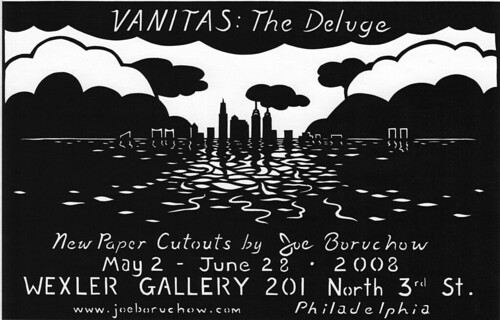
Joe Boruchow-poster (2008 S. Phila.)

Special thanks to my good friend, and the estimable artist, Joe Boruchow. He rather intuitively, and quite graciously, linked me to a handful of New York Review of Books essays in an attempt to legitimize John Updike out of my ignorance and resistance. Quick work was made.

Joe and I had been discussing American artists as I was newly aware of Alsatian-American illustrator/artist, Tomi Ungerer. (I urge you to check the link, especially you graphic-period Warhol enthusiasts.) As is so often the case Joe steered us into the earnestness (or at least matte silverness) of America, tapping into, and sharing, my love of Ben Shahn, Max Fleischer, and George Herrimann. Eventually he alit on Updike, whom as I explained a moment ago, had never worked high in my regards. What he (Joe) really loved were these essays Updike wrote as art critic for The NYRoB. So he sent me a few. I had been drastic in my opinion of John Updike. He's always been too much of a golden calf to really enjoy, too expectedly loved; somewhere there's a back issue of Informed Audience Member Quarterly with him on the cover standing between Joni Mitchell and David Hockney smoking a Churchill. On the wall above the fireplace: Raphael.

The essay, which is sturdy as an Amish nightstand, is called "The Clarity of Things", and it concerns the definition of American Art: For such a presumptuous topic I totally enjoyed it.

I mentioned to Joe that I was moving back to Pittsburgh for a while. In his wrathful halcyon Andrew Carnegie had acquired himself a lion's share of the great American paintings of the 19th century. Certainly I gushed over John Singer Sargent's epiphanous Venetian Interior 1882, and how one of the maids depicted, in her diagonal journey across the canvas, meets with only the tip of her toe a cross-current of sunlight. And how the meeting is no less flagrant and stimulating than when Eve met the Snake. Hearts destroyed, boners attained, privileges lost, etc., etc.

And there were the neo-Classicals--categorical or by warp of history, like Ingres, Courbet, and David who practically fathered the American style (add Walt Whitman and a bay leaf and you're there). In their times they were inflammatory, and at least in Courbet's case, considered somewhat garish for his stylistic determination. I remembered hearing Elizabeth Schumann's sillysad Lieder when I discovered a book of David in a thrift shop years ago. My initial reaction, doubtless emphasized by the metered loveliness of the song--which is why I mention it, was how stealthily David had been an influence on Edward Hopper. The signs are not instantly met. But look in each, and you can find the shared light of abandonment on the figures. It is as if David had taught the American pastoralist a kind of vocational cruelty: you drive them out to the middle of nowhere, in your case Maine, and you leave them there to navigate the light. The results were ecstatic.

So I've made my peace with John Updike, occupation: essayist. My ambivalence for the novelist endures. But then, I don't seem to care for any novelists. Their demands go unrewarded; which of them knows how to finish something he started?! Not so many. Not even the greats. Joe has been reading Willa Cather, and I still tote around Speak, Memory returning to it like a grocery list: I don't want to be surprised, I'm practically 33. How do I feed myself? You'd be surprised how rapid and reliable an answer I get. Perhaps it's not a novel, though it satisfies the demands of one with out griping.

Maybe all style is griping; I still haven't settled on a way to write this thing in a way that satisfies me. A friend, and writer, whose work I respect very much recently said to me, "I enjoy your blog, though I'm not sure I always "get it"". You know, that film is on the insides of these windows too. You scrawl not because it makes sense, but because with your fingers you've, sloppily and with the last mechanical vestiges of being a child, found a way to invite a thing in.

Friday, July 25, 2008

Res Ipsa Loquitur


Stink/Cheat/Torture-I Broke Penny Arcade (Western recent)


Episode Two is now ready for download. It's a smaller chunk, but between the problems discovered with Episode One, and time spent thinking on what discriminating palates really want, I figured cameos were the way to go. I'll be posting more often to make up for the brevity. Plus, because it's such an irresistible song, and was mulched on Episode One, I felt duty-bound to reinclude The Shirelles' "Soldier Boy". Dutch simplicity nothing, that song sounds downright Jamaican.

Here's the rest, with as few words as I can will myself to use:

1. Roy Orbison-Whirlwind So remarkable was Roy Orbison's voice in contrast to his watery and pallid-flesh villainous look, that MGM figured in front of a camera he was bound to take off. Exhibit A. 1967's The Fastest Guitar Alive, and B. everything you already know, coalesce around the truth of it: he did not. The movie sounds like a stinker (I don't lose sleep over not having seen it) and the soundtrack is middling to good. "Whirlwind", the opening cut, is fantastic, barring a lazy fire/desire rhyme, and a seriously fucked up Lolita-esque concept of women. It was the moment that dashed Orbison as a pin-up. Lately, listening to the fantastic second album by Antony and the Johnsons I can hear that bold, quivering sound Orbison invented, and relish knowing he was better off on the right side of the lens. I tend to think of Ella Fitzgerald as the great American singer, but Roy Orbison, I think is more the Grand Canyon. Not a metaphor.

2. John Coltrane w/Hank Mobley, Zoot Sims & Al Cohn-How Deep is the Ocean? Every time I kick my shoes and socks in a pile and lean back to ruminate on what a racist douchebag Irving Berlin was, I'm invariably, inconveniently brought to. The songs are superb. He was a savage motherfucker, and I guess one must forgive the weaknesses of old, when consecrating new hope. Despite the fact that I don't believe what I just said, let me vicariously flatter Berlin even further by adoring this fantastic round table tenor treatment of "How Deep is the Ocean?". This generation of listeners might best set it alongside Television's "Little Johnny Jewel" from the bootleg album, The Blow-Up. Where else might you find such competitive lyrical interplay without cover art involving a Boris Vallejo dominatrix on the spine of her dragon husband. A husband who, I might add, spits blue flames, and has a tattoo.

3. Donny Hathaway-Jealous Guy Hathaway captures all the selfish warmth of John Lennon which, I think, was always his best asset. It was released in '72, in that amber tube of belief that folks would continue to reinvent songs like this. And that slow-pump piano tune is so Bennie and the Jets...

4. Nikki Sudden & Dave Kusworth: Jacobites-Snow White I'm still not quite sure how it has worked out that Kusworth, who wrote this, has not been better rewarded by a grubby-fingers pop history machine that seems ever-poised to rediscover some lost thing. Be that as it may, I think Kusworth gave to the Jacobites fraternity much of the chipped pathos upon which its noble mantle rests. This song will be playing at my funeral, and at Ray's when I leave Philadelphia. A kind of silly funeral too.

5. Uncle Sam-Around the World Girls What an awesome convergence of dancehall and dubstep atoms. Somewhere, not here, the dorky guy is dancing with the nasty Canadian twins to this. Right now, I mean.

6. The Turbans-Let Me Show You Around My Heart Another great Philly doo wop act. That singer is Al Banks of South Philadelphia, a kindred spirit of Frankie Lymon; both modulated in ways that incorporated the feminine and masculine components of the song. I got it from a 78 I found in a box. We should all be so lucky as I am.

and of course The Shirelles.

Oh, and before I forget, I was banging around on the pipes at MagicisTragic's weblog last night, reminiscing over Arab Strap's luxurious 1999 downer, Elephant Shoe; the peanut shells, Rowhouse Red bottles and a brief essay can be found there now. At least I hope I remembered the essay.

Wednesday, July 23, 2008

No, it's an Enclave!


Marcel Duchamp-Fountain (French 1917)

Look for a long overdue corrected Episode One of the Enclave podcast later this evening, followed by Episode Two. Pardon the prolonged technical difficulties, I think the worst of it is in the past now.

Tuesday, July 22, 2008

Repose


Pieter Brueghel the Elder-Luilekkerland (Dutch 1567)


A Few Final Words on Elgar, Godar, Bittova and the lot...


I always imagined myself being the kind of rich guy that brings that really nice berylline bottle of sherry to Millionaire Island where they smoke cigars and hunt human beings for sport. I have seen the sun rise through (the dirtier, emphysematic golden prism of) that very bottle on occasion, though sadly the vignette has not turned out to be the case of my life...

I do like to unwind though.

So imagine the feeling when I checked my mail, only to find some of the heartiest, most analytical and just plain old caring responses I ever got--to the tandem featurettes I logged last Saturday eve and Sunday morning, were submitted secretly.

To paraphrase, while shielding identity, one writer said my effusions over Ms. Iva Bittova went a little too far in certain places, not far enough in others. She pointed out that, contrary to the obvious inclination, the gross sexy parts were among the latter.

What she felt I overstated most were the ties to pop music, that Godar's cycle as it stands, and as spearheaded by Ms. Bittova, is a contemporary palimpsest owing more to early music, eastern European revivalist styles, folk music, Yiddish lullabies, etc..

I gotta say: eh.

I still hear Kate Bush the instant those strings blaze. I liked this person, whom I suspect I sorta know, but can't say for sure, at least not from the email address. She advocated a kind of listening and concentration technique that made earlier recapitulations of Mr. Alex Ross, by my amigo, Alford, seem downright Presbyterian by contrast. Perhaps hence the cloak and dagger. I am both disappointed and satisfied. You wear the aura like a mohawk.

Now one of the "Elgar" correspondents was not nearly as swelling. In fact he was too nice and easy for me to have taken any offense. I admire his economy, though, and his--I suspect, muzzled knowledge of the British composer. At any moment I felt the seam might've split on his opinion sac, and out would've sprayed things only a doting Elgar (great-?) grandchild would know, or worse, some custard-colored Oxonian scholar, whose own diminutive shadow resembles an inverted scallion. This in particular is how I explain the drab, too-knowing knell in his writing, and the total lack of cruelty as well... But without evidence I can't really find in my suspicions. One meaningful fingerprint remains, and it is in the form of a single paragraph, itself small enough to tack on lightly.

Forgive me:

You really overcompensate Elgar his compositional foresight: he did not, as you impress, invent those modern fantasmagoria, [ed. actually I came well short of saying he did!] missing his real contribution: that tightwinding of the craft's flame. He was a kind of noble conservative, if such mammals are to be believed in. In repressive authority you have your Anne Bradstreet, we have Sir Edward, late, hirsute Sir Edward.

I really like that bit about Anne Bradstreet. And the mammalian hairiness of the English, which I never knew. But what do I know?

Next time please use the comments option.

Sunday, July 20, 2008

Silly Fool


Falstaff-Elgar/Boult/Philharmonic Promenade Orchestra (Westminster 1930's?)


The crude snap you see above was taken with my phone-camera. When Miss Kate left she not only took a wedge of my ticker with her but, no less sadly, her digital camera. I scanned in vain the Google image banks for a reproduction of either the Westminster Records (probably late 30's) album cover or the original etching, which I attributed to Gustav Dore, who famously set to image the works of Dante and Rabelais, learning later it was more likely the earlier, Michele Beneditte, a late 18th- early 19th century Italian etcher.

There is something purposefully off-center about Elgar's Falstaff, as if modelled ploddingly after the portly one's movement. I am largely resistant to any piece of music that tries too literally to tell as story better told, well, literally. And given the deep history of this character the feat is no less formidable. However, Sunday morning can cast a spell on the lesser things; this is, I suspect, why The New York Times remains in print.

Elgar's vision is dryly cartoonish, and well-colored at its best. I don't feel the sum of this story is imparted, not that that was ever the point anyway. Certain moments are so fully realized that it is hardly a bother. Falstaff's drunken reverie, "Eastcheap--Gadshill--The Boar's Head; revelry and sleep" as Elgar succinctly calls it, is a particular success. In its maneuvres Elgar lays groundwork for Warner Brothers' cartoon scorewriter, Carl W. Stalling, and the Soviet composer, Sergei Prokofiev, whose 1936 children's classic, Peter and the Wolf seems to borrow some of this dim wooziness. As the man's dream deepens, the music furthers a sad, comical hue that threatens to become serious in spite of its pink color. I am instantly reminded of a young, drunken Dumbo.

I suppose its fitting, that amid the music of a big man under the table, that I too should end up near a swaying elephant. Like I said, Sunday morning can cast a spell...

Friday, July 18, 2008

Someone Turned on the Lights...


Karl Mullen-Untitled


Mater-Godar/Bittova/Valent/Bratislava Conservatory Choir (ECM 2006)

Now it's dark.

Sure it's my predisposition to say so. It was, today, after all, 90-something degrees--an unkind 90-something degrees at that. Just--as was once bandied about in the gulags and other accelerative camps of human disambiguation, like yesterday. Ideal weather to vanish down the rabbit hole as freedom allows.

I say air conditioning is the poison of the modern age. Anything that could turn blue sky into a congestive cell, responsible for sneezes, muscular atrophy and a stiff monthly bill, that could keep the sun behind glass as if component to a museum for basic nouns, must be. I had the blinds down, and the dog slept. Restlessly looking at the mounds of household stuff, I ventured to reexamine cds I had once loved, though never quite as respectfully as I imagined was their due. The things I have loved. I'll say it again, the things I have verily loved.

Iva Bittova monopolizes Vladimir Godar's gut-punching Mater cycle the way all divas must: selfishly. Blood-drinkingly. With an incandescent dynamic not felt, nor feared so, since Fra Angelico ensconced the Virgin in flakes of gold. How apt that a single man, his dog and his now cable tv-free apartment should make the trappings for a delusion.

Just the other day I was discussing my potent milf affinity with a friend, who suggested I might give the opera a go. Lots of mature gals with athletic training. Might be just the thing. Iva Bittova sounds like love. Nightly curious fellows in dark burglar attire, not unlike myself I suppose, are arrested and led from the hind entrance of her home, for climbing a trellis, then through a window, then there, nearly beside her to catch the white petals with cross-running irisine blue lines inside them as they fall from her sleeping mouth, not to sell on eBay, mind you, but for covetous personal reasons, so strong is my milf affinity.

Which makes Mater all the trickier an undertaking; the Freudian snare is bigger than old Louisiana. Godar constructs this cycle as a kind of armchair tour of motherhood, heard in a string of ethnic contexts, set to multiple languages--I counted at least three, and with broadly arrayed emotional and religious premises. What is revealed, not so much contrarily, as secondarily, is the pulsating eroticism this endows Ms. Bittova, who inhabits these roles of the unfurling of womanhood, with a kind of pink multiplicity. Mind you, there's some anguish and grief expressed in the course of Mater, which I readily set aside with reverence and all due civility; I'm no wackjob.

Godar, in a composer's note, discusses the prison of narcissism into which we fall when we neglect either parent or child--that we are not only bound to duty, we are so bound against the perpetuity of all time, that if we can imagine, as is so helpful, the path stretches once to the dimming age we'll reach, and backward to the genesis gone by. So I have to agree with him, a fool would stray and not taste that sour magnificence each moment thereafter and be called a bad son of the Earth.

But wait, I wanted to address something, you know, sexy. Perhaps best that I said my peace about goodness first. For if there is any resonant lesson in Mater to be found it concerns the rich, reflective joy available between a selfish, and selfishly burning voice, and the more than nearly delusional thirst that waits, listens and consumes it like a wise and patient cactus in the sun.

Certain moments, the flamboyant "Regina Coeli" for example, a basic "he is risen" yarn Godar informs us originated in Slovakian early music revivalism (!!!), are magnetic. They open such brilliant vocal territory to Ms. Bittova that, ecclesiastical subject be damned, her irrepressibly sensuous sound flattens all secondary notions. Not that the godly and sexy are mutually exclusive. In Daniel Wolff's trenchant, You Send Me: The Life and Times of Sam Cooke, the author goes so far as to say lifelong spinsters actively sought sexual gratification in the tremulous fire of gospel music. The difference in this case being my happy inclination to fetishize the reward.

"Magnificat" dwells, with its plunging icy strings, near the earthly spiritualism (!!!) of Kate Bush's "Running Up That Hill"--even if, anachronistically, Ms. Bittova puts me in mind of Lisa Gerrard of the curiously maligned, Dead Can Dance. But it is that precise flirtation with pop music--not the exhaustive linguistic, archaeological and compositional density, which gives Mr. Godar's work such heft, and Ms. Bittova's performance such dimension. It has a wise timeliness--when's the last time that happened without the Kronos Quartet, the art department at Nonesuch, and a shoe horn?

I don't want to sell short the academic achievement of Mater, nor especially the thrilling execution--it, I confess, never feels a fraction of the haughtiness its erudition suggests. This grace and agility with heavy objects in pop music simply does not happen.

My current thoughts however remain with that woman flitting through this rigorous septych. One can hardly cast stones at a man in my position, whose mereness of gratitude sets after fresh air, rabbit's end, and fabulous women. That it might all find me too.

Am I right or am I right?

Tuesday, July 15, 2008

O, the Ways to Read, w/notes on Podcast Episode One


A quick word:
Some readers have responded over the last few days, having found irregularities toward the end of Episode 1. The issue is being reviewed, and should be corrected shortly. Thanks for listening...


Episode 1

The first time I ever picked up a copy of the Torah I scratched my head like a monkey and wondered how one book so important to so many people could have suffered such an enduring publication blunder as to have been printed backwards. I always loved the Chinese alphabet, especially as a kid, with no bearings, thinking the characters were cryptically random arrangements of twigs and thorns. If I had been a Chinese kid I would've drifted away from the classroom each day in one of those little cages. Now Hebrew, on the other hand, always seemed to have a sense of humor in its shapes and proximity: lots of arched brows, hands on hips and pursing lips in those backwards-running figurines. Most erotic, though, is English in Stempel Garamond, into whose lowercase e I once momentarily withdrew from Emily Bronte's Wuthering Heights in a flash infatuation with the arched roof of the character's mouth. I wouldn't mention it, something so immaterial to our purposes together, but the way these blogs run in a straight shot down means you read the update or post-script or what have you before you've had a chance to read the mother article.

It is what it is. Here are but a few passing observations, some concern the music, others the records I used. I won't say there'll be zero cds used in the Enclave Podcast, but I'll certainly do my best to limit their presence. Nothing against the things--I'm no Steve Albini. I just love records and would sell my hands for more.

The Songs

1. Nat King Cole-Nature Boy (Capitol 1948) Depending how long a view you're willing to take of weird America, Cole's recording of Eden Ahbez' neo-pagan lyric came either several centuries too late or fifty some years too soon. I regard it as a kind of feral forebear to the Animal Collective/Vashti Bunyan "Prospect Hummer"--though to call this song feral is rather misleading. Still, the two share a kind of prehistoric magic. Cole's curious orchestral song must have been a great shock, so unlike everything of its time. It's so confidently homoerotic and nocturnal--it would make a fine opening song to a movie of The Secret Sharer, and was was the opening track to less homoerotic, yet equally nocturnal, The Boy with Green Hair. I have a 45 of this lying around, though this version was taken from a much more degraded 78. The accumulation of damage-induced noise only accentuates the paradox of its ancient notion and pristine rendition. Way essential, and a great way to kick things off, I say.

2. John Barry-Nobody and Nothing (United Artists 1967) From American mysticism to British. Soundtrack music peaked anew in mid to late 60's British mysteries (the intoxicating Hermann, Rosza, and Waxman themes of the 30's and 40's being the first great wave). There is little more than harpsichord and slow nylon string guitars, as if mere remnants of of an older living sound now gone. Even with the occasional embellishment from the orchestra these recordings epitomize the damp, meditative psychological tenor of the movies. Barry, famous for the exact opposite (the brash James Bond Theme for example) developed a rich, spooky sound that doesn't just mirror the pace of Brian Forbes' gothic drama, The Whisperers, it actually slows it down.

3. Margaret Greene-Learning to Talk-Two Years Old (Folkways 1963) Bought it for the cover, it turned out to have a great sound.

4. Berlioz/Sir Thos. Beecham/The Dulwich College Boys Choir/The Royal Philharmonic Orchestra (Columbia Masterworks 1955)-I mentioned this one in my first post. A terrific large ensemble piece, with wonderful sensitivity to space. Sounds like it was recorded in the Grand Canyon.

5. Colleen-The Golden Morning Breaks (Leaf 2005) So many folks nowadays make instrumental rock records and in doing so cheap out on some of the most important elements, the most obvious of which are the voice and lyrics. But what also too often happens is the whole song structure is lost. Blame Godspeed You Black Emperor (faithful readers by now must realize I blame them for a lot of things), or The Shipping News, or go back to the 70's wankers, the 45 minute drum solos, et al. It's hard to blame kids today, seeing as they're really second generation songless musicians and listeners. But whatever the era, history is rich with self-indulgent merrymakers who figure if I'm having a good time they must be having a good time too. Colleen appears to fit right into that lot. She records for the instrumental/new-house label, Leaf, she plays harp in a rock context, and her style is purely evocative. I excuse her entirely, though, from the accusations above. Like very few other of her generation she seems to have learned that valuable, if tricky, lesson from Satie's small, bone simple compositions: from note to note there must be some connective curiosity. It can't just be music for bubblebaths. Well, it can, but , you know, give people who take bubblebaths a little credit. They like the thoughtful, intelligent storyline too.

6. Hank Ballard & The Midnighters-Please Forgive Me (King 19??) Fine Bessemer, Alabama r&b. I love this late 50's/early 60's period of soul the best: the gospel fire was manifesting itself in new secular ways, and the crooner discipline still gave he music a kind of earnestness soon to be lost in the psychedelia of the mid-60's. I'd guess this was recorded sometime around 1960 or -61, owing a debt to the plaintive "Try Me", by James Brown--or perhaps the other way around.

7. Ivory Joe Hunter-Gimme a Pound o' Ground Round (MGM 19??) I found this curiosity in a cheapo milk crate at Beautiful World Syndicate. I bought it for the song title. The carnal euphemism is as disgusting, hilarious, and glorious as any I've heard in pop music--and that includes The Frogs. Somewhere a John Waters movie's doggy-style dryhumping scene is missing its tune...

8. Hubert Laws-Baila Cinderella (Atlantic 1963) I picked up this, Laws' 1965 lp, Flute By Laws and Byron Lee's 1967 Jump Up, within a week of one another. The former was a reccomendation of an esteemed Afro-Cuban listener/producer pal of mine--who in a reverent tone pointed out the name of Israel "Cachao" Lopes in the liner notes, the latter I just took a chance on. Over the course of Atlantic's 60+ year history they've not only made some of the quintessential American recordings (John Coltrane's Giant Steps and Ray Charles' What'd I Say to name but two off the top of my head) but they've help push the perimeters out into the realms of the undiscovered or just plain caricatured world musics. Laws' salsa is indistinguishable from straight dance music, probably because it is dance music. As notions of jazz split into camps of asses and brains there were dynamos like this who managed to appeal to both. It is tremendous fun.

9. Bobby Darin & Johnny Mercer-Bob White (ATCO 1960) This spotless classy objet d'arte came from a recent excursion out west, to Jerry's Records in Pittsburgh, with old amigos Dan and Todd. The teamwork here is reminiscent of the Bing Crosby & Bob Hope road movies. Lots of arch repartee, indulgently bad jokes, and an outer sparkle missing not just from the music of our moment, but from the moment itself. A kind of laughing portent from the old long since.

10. Thelonious Monk-Tea for Two (Columbia 1963) From perhaps the most listenable record on my shelves, Criss Cross. Belongs in a museum.

11. Jo Stafford-Once to Every Heart (Columbia 1952) I can't hear songs like this without linking them to the sentimental vignettes they often filled in movies. So far though, I haven't found any sign of it having turned up in one. Check out this from an October 1952 issue of Time magazine for more dope.

*In a strange, sad coincidence, The Daily Telegraph announced yesterday Ms. Stafford, age 90, passed away. You can find that obituary, which is quite comprehensive of her life and career here.


12. ?-untranslated tune from lp, Russian Balalaika (label unknown 1977) The cardstock cover is printed in a long-lost shade of sage-honey orange, with greens that bled across the years from an old Maury Sendak storybook. The disc itself is sunny translucent gold. If I ever marry, it'll be to this record.


13. Alton Ellis-I'm Just a Guy (Studio One 1960s?) Familiar though no less superb rocksteady gem. Another fine example of the distressed condition of a record gilding the edges of its own classic aura.


14. Lee Andrews & the Hearts-Long Lonely Nights (Main Line Records 1957) Most young Philadelphians these days know Lee's son, Amir's band, The Roots, better than the doo wop father. The Roots are a formidable landbridge between old forms (jazz, doo wop, blues and such) and new hip hop. So count among their inheritance the DNA of great Philadelphia songcraft; this is one of the evocative greats, with a chorus etched on the imagination's night in long longs and loping lonelys. Pure euphony to match the pining, perfect harmony.


15. The Clash-The Card Cheat (Columbia 1979) Like Shane McGowan, Joe Strummer had an uncanny facility with bygone folk narratives. I haven't yet seen the Julian Temple movie, Joe Strummer: The Future is Unwritten, though having spent time at the store with the soundtrack it is clear the kind of juxtaposition that was made between the vast years and styles of music Strummer absorbed, and the kind he made. "The Card Cheat" tells a simple tale of the title character being caught in the act, in a way that somehow feels epic, universal, and tremendously meaningful. It's as though in this lowly cheat's moment of reckoning, when his life is blinking away before him, the weight of western sin and possibility somehow manages to squeeze into the mix. A mighty vision.

16. The Shirelles-Soldier Boy (Scepter 1962) It is tremendously difficult to address the girl groups of the early and mid-sixties without either plying the reader with copious fact-based downers, or frosting them with hackneyed approbations. So difficult, in fact, is it that I'll refrain.

17. Christian Fennesz Plays Charles Matthews (Touch 7 2008) Fennesz has managed to shape his post-halcyon career with the kind of restraint and calculation pretty much unparalleled among his generation. Sure Kevin Shields has stayed busy over the years, but the yield has been erratic, and tacking towards modest embarrassment. Fennesz, on the other hand has seized his moment as a kind of second generation new composition figure, to basically do what Brian Eno did with pianist, Harold Budd's diaphanous playing. Like Eno, Fennesz makes the production role a vital, inextricable event from the ultimate musical entity, first with the miraculously pliable Ryuichi Skamoto (Cendre, Sala Santa Cecilia) and most recently with this limited edition 7" from March. It reveals Christian Fennesz' Breughel-like capacity for wild detail in a natural panorama. The processing of Matthews playing [the grand organ at York Minster] so reverently nods to Eno's arrangements of Budd--and does so with such uncannily subtle texture. The refinement, and convergence of sound source and and receptive modifier, has given birth to a difficult new question about the boundaries of natural authorship, even as the listener snaps back from a primary musical hypnosis. Who says limited edition 7"es can't change the world?!

18. Roy Smeck & the Music Men-My Little Grass Shack (Sonora 194?) Roy Smeck, born Leroy Smeck, America's answer to Django; Reading, Pennsylvania's answer to Harpo Marx. The guy's head ought to be on the dime.

19. Beethoven/Dietrich Fischer-Dieskau-Adelaide (Deutsche Grammophon 1965)

Monday, July 14, 2008

The Central Pennsport Listeners Enclave: Episode 1


It's a bulky name, but if you were my neighbor you too would seek phantasms of non-vehicular self-expression. Click the link below and download episode 1 of The Enclave podcast. You will find that over the next few days, if not weeks, I'll be doing a little fine-tuning in an attempt to format everything correctly, and add some sense of practical order. Kindly email me any problems you experience downloading. I'll address them as best I can.

A few quixotic listening notes will follow as well.

On an unrelated note, I reappeared on Magicistragic's weblog over the weekend, giving my opinion on the terrific 1985 Nikki Sudden and Dave Kusworth/Jacobites record, Robespierre's Velvet Basement. Special thanks to the head Magic man for helping me set this up...

Episode 1

Friday, July 11, 2008

The Rigid Swing


Last night at the old watering hole I got a response from my pal, Brian, on the Glenn Gould: A State of Wonder cd I fitted him with a few weeks back. From sitting next to the guy so many nights on the stools I picked up on a songwriter's empiricism--it's not so different than the crossword puzzler's variety actually. As such I pegged him a good fit for Gould--especially as other discussions revealed that, despite a seasoned education in music theory and a life in bands, he didn't have a lot interest in listening to classical music, rightly observing that much of it is boring.

Naturally I found the challenge appealing, seeing that few metaphysical concerns arise which Gould's recording cannot not assuage. Only mildly would I say that last is an overstatement, by which I mean it is a complete lie I believe with spiritual certainty. Not that you asked. That first recording of The Goldberg Variations in particular (1955; A State of Wonder also includes his 1981 recording of the same pieces) is made of such sturdy, confident strokes; in the pianists world, the Odd Couple might well have been a young, fastidious Gould, and a sweat-streaked piano-poking trickster, Thelonious Monk.

But back to Brian. I anticipated him making some incredible connections between Gould and the baser world the rest of us occupy, and he did not disappoint. He remarked that, played back to back with Van Halen's (eh) Fair Warning, Gould held up fine. It wasn't a "Devil Went Down to Georgia" showdown of chops and virtuosity; the guys in the guitar shop where he works, and where this listening took place, just figured there wasn't enough of a seam in the energies of the abutting forces (Gould vs Van Halen) to shift away from either. Brian was pleased that Gould's music produced hooks, just like in pop music. It's kind of a funny way of thinking about it, when you consider the conspicuous air of discipline and exactitude (not that pop music cannot have both as well). He's right, the idiosyncratic qualities of Gould's playing are unmistakable and magnetic.

Kevin Bazzana's excellent biography of Gould, Wondrous Strange: The Life and Art of Glenn Gould (2005), commences with a litany of peculiar affections the Canadian pianist and producer garnered, the like of many of which might make the reader feel Bazzana had strayed into the life of John Lennon or Jimmy Page. He had groupies and nutjobs professing fear-striking love, the rapt attention of academics, headshrinkers, and fellow artists. His biographies and homages are virtually impossible to count. Once, after a few too many whiskeys I recounted the story of some Russian chess players demanding that Gould's playing chair be dismantled, and searched (while they watched) to prove no secreted devices were piping him in the incredulous answers he revealed. Suddenly I realized I was talking about the late chess champion, Bobby Fischer. Maybe it was that they were both reclusive genius Jews with rabid followings. Maybe it was the whiskey. I like to think it's that what made Gould so mystifying was, and is, the very sort of thing that would madden Russian chess players, maybe thereby elating the rest of us. A kind of laid bare impishness. It is cool and impossible to be that way.

Wednesday, July 9, 2008

Three Places in New England (that don't suck).


After last nights readings at Brickbat, the subjects turned to ex-boyfriends who own quarries, and Danbury Connecticut. I thought about Charles Ives, born Danburian, and once called the greatest composer of the twentieth century. I say once because in the silliness of the last 40 years we seem to have replaced him with Ligeti. As if at Heaven's Gate we might get in faster if, to Peter's entrance question, "What's your favorite food?", we piously answer, "Why coal of course! Chilly rocks made of shit, centuries and old debris."

Peter: "Just go in already..."


Ives' Three Places in New England, alternately incandescent and dim--and referential in a spastic, forward-thinking way, owes at least part of the sublime quietude of "The "Saint Gaudens" in Boston Common " to Mahler.

The cosmic spirituality of Mahler's Ninth Symphony must be one of the most sophisticated and, at the same time, obvious (to us douchebags) signifiers in western music. I say that with the comfort of knowing that huge swaths of Mozart, Bach and Beethoven have been neutralized by contemporary, and constantly (re: mercilessly) renewed efforts to borrow on their familiar metaphors of historical or religious grandness; emotional exuberance; and intellectual pageantry. In the initial, startling swell of strings and horns sits, plain as the nose on your face, a sense of frightening, still perfectly calm, travel. It's pure death.

Now I'll admit I am partial to morbid expression, and that when lacking I'll find it anyway. But with Ives as my Rorschach test, I feel less like I'm fudging the facts than I am impressed with a thematic sense of finality that is very much active--if subtly. The green solemnity might mark different land than Mahler's Grand Canyon-esque death vistas, but the effect is comparable. That idea of returning to the earth isn't merely a reconciliation with the body's decay, it is a spiritual metaphor for the places from which we draw our most mortifying sensations of life.

Charles Ives, like the lot of twentieth century composers, always struck me as a kind of a hassle. Like Frank Zappa, or Flipper. One more thing I gotta sit through, just to say I sat though, in case, over cheese or a goddamned Malbec, it comes up again. I was pleased to find great range of color in Ives' Three Places, that its challenges were almost purely aesthetic, and employing none of that geeky twentieth century ugliness I'd come to distrust--and immediately disliked. Immediate are the nuanced natural elements, cast with symphonic size and proximity. But in the distance phantasmal piping of war fifes provide a supernatural touch, as if this place where long-gone soldiers gathered had somehow managed to hold that music in space as part of its natural identity.

Those war themes turn to bombast in the second part, "Putnam's Camp, Reading, Connecticut". In it the embedded battle themes overwhelm the "natural music", severing that rustic attractiveness, that quietude. It's not until that final part, the roiling "The Housatonic at Stockbridge" that the wild, Whitmanesque elements return to the center of the affair. I might argue that ghosts, more so than death, are the significant theme, that these three Places represent infinite variations of past lives, and inhabitations. Of course it's possible that Ives simply captured the basics of his subject, haunted as they were, without making so petty a distinction.

Tuesday, July 8, 2008

Silly things


On a Saturday evening about three months ago I picked up the lp, Person Pitch, by Animal Collective's Panda Bear, on my way out the door at the store. I'd only heard it once, and compared to the elegiac Young Prayer, which he composed for his late father, I found the new work a little tainted by more popular contrivances--especially those throwing back heedlessly to Brian Wilson's broad-swath sunshine sound. But the consensus was good.

I haven't opened it yet. And it's possible I only bought the record to feel better about the day--I may never open it.

I bring it up now because coming off a few days of creative dryness, following a horribly botched meditation on an old doo-wop record--a favorite, which only makes it worse, I considered swinging by the bins at Beautiful World Syndicate to see what $5 or less could buy.


This last week has proven psychologically challenging from a listening standpoint. As I continue to discover the rambunctious side of Schubert there is precious little resistance in the air; if we buy records to placate ourselves, we actualy listen to them to chafe ourselves, or at least chafe others that the friction might return to us.

Sadly many stores no longer carry classical music, or if they do they're worn out selections, picked over for strong recordings of popular titles. Popular, such as they are. All of this makes the process feel somewhat empty, certainly less exciting. You don't get that cagey feeling coming across a 78 of Alfred Cortot's Chopin performances that you might get from seeing a clean mono copy of Another Side of Bob Dylan--though the former in market terms might exceed the value of the latter. It's just not that cool. No one's going to call you a dick for finding it first; and in his head the owner is kissing Christ's sweet feet that that useless, dingy thing is finally leaving his store.


Last night, after walking the dog and seeing a peculiar barefooted man on the glassy sidewalks around 5th & Tasker, in the heat with hardly any streetlight to show the way, I had a flashback of something I'd read a few years back. Anthony Bourdain described his awkward college years in a single image, which I'd say speaks to the wilderness of social awkwardness out there. He was, as he wrote (and I paraphrase), that kid walking across campus with the samurai sword in his belt. Not, I should take the license to point out, on his way to a martial arts class, nor a weaponology seminar, nor even a trade show where such things are often bought and sold among minds liberal to those objects. He was likely going to the cafeteria, or maybe a parking lot wall to stand and spit. I was struck by the thought of Bourdain, as with this mysterious night creeper, how silly we must seem no matter what we do.

Wednesday, July 2, 2008

The Mule


First, I must thank Alford--who if I'm not mistaken, is the gregarious music enthusiast, John Armstrong of old Third Street Jazz fame (please correct me if I'm wrong), with whom I've shared many a compelling food anecdote, favorite among which is the one I described in To Stink To Cheat To Torture, concerning him curing a ham in his apartment and drawing mice in the process; he fights the good fight. Alford's comments on my first entry, a self-conscious piece of opinion, constitute the first practical advice I've had in too long. I'll be picking up the promoted titles by Beethoven and Schubert, and listening in the prescribed fashion. Wild responses to follow. Gratitude sooner: thanks.

For now it is the lightless portion of the dawn of this singlehood. Miss Kate readies her apartment in the North, while I get my bearings and prepare to live without her. But the dim element of dawn has nothing to do with her; it is a self indulgent hue in me that adheres to the dark when it suits my whim. Furthermore I was referring to Chopin's Nocturnes, performed by Eugene Istomin, and released (yet another) by Columbia Masterworks in 1956.

The chief obstacle of this generation in connecting with composition would appear to be complexity-at-length. Succinct Jackson Pollock never hurt anyone--you take one look and decide at that moment. Is it beautiful; does it mean anything; am I a part of it?

But these musical things, they take time to absorb: first a fundamental notion of the work concerned, then God knows how many variations til death. Chopin, I'd always found just pleasant, but only because I wasn't really paying attention. In peeling back the onion of these works, one can detect a virtually endless interspersion of romantic pageantry, and abysmal psychological nuance. No pretty flourish runs so far without a kind of crumbling finish, a dulling turn, or some other musical device that, for my lack of erudition, I'll simply say disrupts the pleasantness. Perhaps Chopin's approach was clinical, seeking to uncover unpromising and unfulfilling, and indifferently unbeautiful aspects of a thing to which we too eagerly attach generalized notions of beauty and possibility, rather than knock off, one after another, a series of cliches on the subject.

Some of them border on the grotesque, or are outright unsettling. That they come in the guise of quasi-lullabies only advances the possibility that Chopin had a real misanthropic streak. Truthfully I wouldn't know, not in the historical sense anyway. The convenient--and lazy, core of what I'm doing forces me to react without research. I don't mind putting in research (which is a flat out lie), but it would defeat the purpose to look for scholarly answers. After all the feelings are anything but, so why should I get dressed and put on my glasses. Where am I going?

In fact if Chopin's practical magic can touch our lives at all--and it can!-- then it would do so as a kind of prescient experiment into, not the purpose of music so much as what we actually do with it. Music to exercise to, to dance to, to do the dishes to, to sleep to. Why the Nocturnes! They're perfect. If Three Men and a Baby is to be believed--and it is!--then its not what you tell a baby, its how you tell it. It couldn't possibly end when we're infants, though. Perhaps the magic wanes, but our susceptibility improves over time.

Thusly did Chopin invent, with his Nocturnes, the police scanner years ahead of its technological birth, that eerie device in the homes of curious people who drift away at night to the lull of their civilization in its relaxing back-and-forth of violence and response.

It makes me want to laugh; what I don't know about Chopin convinces me he laughed at it--the possibility of it, impressed as he must've been with the mule of the night.